Overture: The Whole Machine
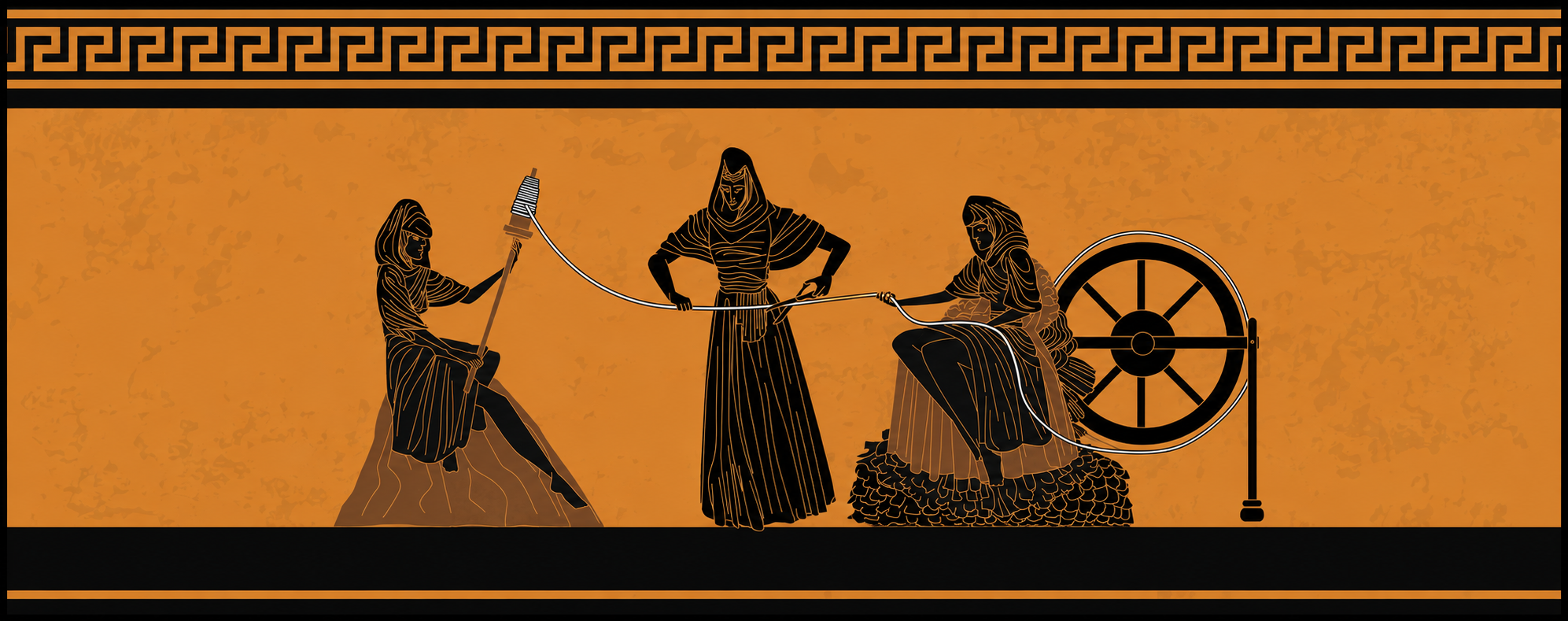
At the end of the Republic, Plato sends a soldier named Er to the other side and back. Er sees the souls, on their way to be born again, brought before the three daughters of Necessity, while a great spindle turns on her knees and carries the heavens around it. Each soul chooses a life from the lap of Lachesis, the choice is ratified under the hand of Clotho, and Atropos makes the spun thread impossible to turn back. Then the souls drink from the river of forgetting and are carried off to their births like shooting stars.
Our own quarrel between free will and determinism starts much later. It starts with a person already inside the world — already embodied, already formed by a family and a language — who deliberates. Then philosophy asks whether the decision can be free if the state of the world already fixes what comes next. By then, if anything decisive ever happened, it has happened already.
I propose to move the decisive act back upstream, where Plato put it, and to change almost everything else about it. Before our embodied history, each of us may have contributed a choice of a few existential themes — kinds of exposure, relation, vocation, loss and authority — and never the scenes of a biography. Because lives intersect, those choices are woven together into one coherent world before any world is spun. History then runs as one actual order of causes, with a small share of it still genuinely open.
an antecedent choice → a limited menu → one woven world → a physical start → a history that only runs forward
Plato has most of that sequence, in a cruder form. His souls choose complete lives, each on its own, and no one asks whether all those lives can exist together — themes in place of lives, and the weave, are what I add to him. The heaviest debts, who makes that first choice and in what mode, get a section of their own and are still unpaid.
Thermodynamics gives the resulting history its direction, and astronomy gives it a clock everyone shares. Astrology is a separate and defeasible extension on that clock, the proposal that the sky also works as a calendar for the seasons of a life — to be tested, never consulted, and dropped if it fails.
Three things are ruled out from the first page. Nobody chose the scenes of their life, only its themes. Nobody owns a private fate, since every biography is a local stretch of one world shared with other people, natural laws and collisions no one planned. And no one’s suffering may be read as consent: an event can belong to your life without having been chosen by you, and another person’s wrongdoing stays theirs.
Plato, Genesis, the Qur’an, Aquinas, Plotinus, Boethius, Jung, thermodynamics and the Buddhist cosmologies do not secretly teach one forgotten doctrine. Each is called for one part of the picture, as an anchor, a witness or an analogy, some for it and some against it, and the References keep the record.
Before Difference
Before difference is a boundary in thought, and not necessarily a moment on a clock. It names the person considered before the physical run has set them apart, through one body, one family, one language and one sequence of years.
What I claim on the far side of it is deliberately thin: a choice, and that it was yours. About the state of the one who made it I claim nothing — not a previous life, not a consciousness, not even the lack of one. My interest is narrow, fixed on one motion and what becomes of it, and not on its billions of underlying conditions.
Several traditions offer precedents without handing over the theory. Genesis gives a root act whose consequences outrun the moment of choice. The Qur’an (7:172) gives a primordial affirmation of the children of Adam before their Lord, bound to an accountability no one remembers. Plato’s Myth of Er comes closest to the mechanism itself. None of them is the theory, yet together they show that identity, responsibility, choice and memory were not always assumed to live at the same address in time.
Er tells it as a story, with the souls choosing one after another, because a story must happen in some order. Plotinus had a rule for exactly this — myths separate in time what in reality exists together (Ennead III.5.9) — so Plato’s before can be read as a before in depth, and not in time.
Relocating the Choice
The standard free-will problem makes freedom and determinism fight over the same joint. If the state of the world, together with the laws, fixes the next state, where exactly does an undetermined choice get in? Ordinary compatibilism answers by asking less of freedom: an action is free when it flows from the agent’s own reasons and character, even if those have causes of their own.
Instead, I grant something closer to the libertarian’s sourcehood — the agent as a real origin, not only a channel — and relocate its strongest form upstream, to the conditions under which our history is realized at all. Deliberation still happens, and our weighing, persuading and acting all belong among the causes of history. I deny only that the deepest authorship must be re-created, as an uncaused opening, at every single moment.
Compatibilism is enough if freedom means acting from a character we can call our own. Yet that character may be received whole, from heredity, upbringing and a history we had no hand in forming. A Thomist will rightly answer that God’s causing never competes with ours, since He moves the will as a will, but the question survives, because it asks whether we had any part in the shape of what we were given. Compatibilism secures a free execution, while an antecedent choice reaches for a hand in the executable itself (Research Program §1.4).
Moving the choice upstream does not, by itself, settle anything. If the antecedent choice only expresses a character already fixed, the old problem has merely moved back a step; if nothing prior fixes it, we owe an account of what separates an origin from luck. This is precisely the libertarian’s oldest debt, the first-act problem. Until it is paid, I can say where I want an origin to be, but not yet how one works (Research Program §1.5).
Insofar as a temporal decision expresses the agent’s own antecedent contribution, it is the concrete unfolding of that contribution rather than a second origin of authorship. Call that unfolding decompression. The chooser did not hold the later scene in view, and the scene is one concrete form the woven themes take within a life. Deliberation, refusal, effort, and error remain genuine acts and genuine causes in that process.
Decompression here is what a seed does, not what a zip file does. The concrete scene is not stored inside the theme and then unpacked, since a seed holds almost none of what it becomes. The willow van Helmont grew in the 1600s gained more than a hundred and sixty pounds in five years, and its tub of earth lost about two ounces. Yet an acorn still makes an oak and never a pine. The weave, other people, natural law and inherited history supply what the theme never contained. A decision made in response to what someone else did is a real decision, and it is not the unfolding of my parameter.
Some decisions are neither an unfolding nor a response. They are new, the one thing no seed contains, and I do not think they are many; they live mostly in the day to day. But we share something like ninety-nine percent of our DNA, letter for letter, with the chimpanzee, and that one percent makes all the difference; a sliver of genuinely free choice is enough to change how a whole shared history gets expressed. Most of a life is given and a sliver is chosen — not as a share taken from God, since He is the first cause of our free choices too, without making them any less ours.
So I would not call this compatibilism. It is fate for the frame and freedom for the texture: the themes, the weave and the arrow of time are settled, while the form each theme takes, and which of its dates we keep, is where the sliver lives. In two Greek words, ontos and ethos — what the weave settles, and how we live what it settles.
The Limited Menu
The naive version fails at once, and Plato’s own souls show how, choosing whole lives, concrete down to the ending, from patterns laid on the ground before them (Republic 618a). Complete biographies cannot be chosen independently. Two candidates cannot both win the same election, and one person cannot marry someone who has chosen never to meet them. A parent cannot choose an early death while a child, on its own, chooses a life in which that parent is never lost. Lives are intersections, not separable programs, so what is chosen before the world must be less concrete than a biography and more binding than a slogan.
What is chosen is a theme — a parameter, in the drier word of the References — together with a known range of ways it can play out, while the concrete event stays open.
known theme → known range → unknown scene
Separation can arrive as migration, bereavement, retirement or renunciation; authority as parenthood, office, the care of the weak or a long war with a superior; creation as art, research, children or an institution. The list shows the level I mean, and it is not a canon.
This middle level is hard to specify and impossible to skip. If any life counts as a realization of the theme, the choice is empty, and if the theme already says who, when and by what act, the script is back. Plato stages a failure and a success in one scene. The first soul to choose seizes the greatest tyranny without examining it, and only afterwards finds in it the devouring of his own children (619b–c). He knew the theme and not its range, and he chose from a virtue held only “by habit and not by philosophy” (619c–d), a character formed before the choice — the first-act problem in miniature. Plato blames him all the same. Odysseus, choosing last, looks a long while for the quiet life of a private man and says he would have taken it with the first lot too (620c–d); he knew what he chose and what it could hold.
A valid theme, then, binds the future enough to be the chooser’s own, and leaves the concrete form open to the weave, to other people and, in its small share, to the chooser’s sliver. That also blocks the most destructive reading of an antecedent choice. Accepting a risk is not choosing another person’s later act: if A harms B, the act stays A’s, and the presence of a harm in a life is never evidence that it was consented to. You chose your life is too blunt to say, and the most I would say is that you may have helped shape the space from which your life was realized.
The vocabulary of themes is itself an open problem. A mature list would have to generate many lives from few themes, recur across cultures and keep scenes out (Parameter-basis problem; Research Program §2). Jung will matter later, because archetypal thinking treats very different events as instances of one recurrent form, but Jung does not hand over the menu.
Integration into One World
Once the menu is limited, the question changes from what did each person choose? to how can all of it exist together?
There is no private fate. A life is made largely of other people’s choices, of inherited institutions, physical regularities and accidents; a migration decides the lives of descendants not yet born, and a war connects people who never meet. An antecedent choice, if there is one, can only be honored at the level of a world.
Each of us is, in this sense, a link — downstream of our parents and grandparents, of the country they left or the one they never left, upstream of whoever comes after, sending the effects of our small choices into lives we will never see. Anything reaches a life through one of two channels. Authorship is our own themes and whatever we decide in living them, the sliver included; influence is everything that arrives through the one shared world, other people’s sins included.
Adam shows both in a single figure, since his choice was his own authorship and what reached us from it is influence. Original sin, in the Catechism’s exact words, is “contracted” and not “committed” (CCC 404), passed on “by propagation, not by imitation” (CCC 419). Scripture keeps the same line for every generation after him, visiting the iniquity of the fathers “upon the children, unto the third and fourth generation” (Exodus 20:5), and yet “the son shall not bear the iniquity of the father” (Ezekiel 18:20). Consequences travel down the chain and guilt does not. That is the honest answer to generational curses: whatever their spiritual side, we are bound to a past we did not choose — as heirs, never as defendants.
The weave, which is providence seen from the side of the threads, is how all of it comes to stand together. Many limited choices must be made compossible, able to exist in one complete world, before any world is spun. The word is Leibniz’s, though his possibles never choose anything, and no classical theologian described providence as a weaving of choices. How the weaving works remains open (Schematic notation; Research Program §2.1).
Who, then, authored the intersections — the meetings and collisions that make up most of a life — if everyone chose without seeing anyone else’s choice? None of the choosers did. The intersections belong to the weave, and they are exactly what I mean by fate. You author your themes, and their crossing with everyone else’s is fate, woven with all of them at once, so there is no first chooser to envy and no last one to pity.
Nor does everything in the weave weigh the same. Some constraints are hard and some soft, some need another person, some only permit a risk and some forbid outright, all of them within natural law. Those differences keep providence from becoming a utility maximizer that launders every outcome as best for the whole. When one person’s choice harms another, the real question is why this world permits that intersection, and what honoring the victim’s themes can then mean.
Plato wrote his own answer into the speech that opens the choosing: “The blame is his who chooses: God is blameless” (617e). It is the most dangerous sentence in the myth, because it turns every suffering into a signature — and his own first chooser refutes it, since no one asks what the children chose. When the disciples bring Christ the same inference about a man born blind, He answers, “Neither hath this man sinned, nor his parents” (John 9:3). What I propose moves the problem of evil without solving it, and a theory that made every victim the secret author of their harm would be worse than the problem itself.
Harm done with someone’s sliver is that person’s authorship and only influence for the one who suffers it, so for that share of evil the old free-will defense still holds. But a free sliver could, in principle, surprise the weave, and two answers meet it. A tire is full of small defects and yet, rolling, reads as a perfect circle, because the frame is coarse enough to land through almost anything anyone does with a sliver. And beneath that image, God does not weave from inside time, waiting on our choices. He sees every free choice in one eternal present without making it necessary, as Boethius taught and Aquinas after him. How that sight becomes a weave is the old quarrel between Thomists and Molinists, and I do not settle it here.
Who Chooses, and in What Mode
Everything so far has been borrowing against two debts, and here they come due. The first is that the chooser has to be you. If some other being chose the themes and I only undergo them, sourcehood has been outsourced, not relocated, and the whole picture becomes a more elaborate way of being ruled.
Memory cannot carry that identity alone. People forget most of their lives without becoming new subjects, and in Er every soul drinks from the river of Unmindfulness before birth (621a). Er and the covenant of Alast imagine responsibility across a gap no memory crosses, and divine individuation, God calling a person by name before they know themselves, adds that being known can run ahead of knowing oneself. None of this proves that the chooser and the one who lives are the same person, but it makes the question intelligible.
Because I claim only a choice, I am not bound to one account of what carries identity across, though some account deeper than memory is still owed. Soul-continuity is the clearest candidate, but it pays one debt by opening another, since a soul existing before its body is not Thomistic hylomorphism. Aquinas holds the human being to be one composite of body and soul, and says outright that souls “were not created before bodies, but are created at the same time as they are infused into them” (ST I q.118 a.3). I can borrow him on God, providence and the two levels of causation without pretending he supplies this anthropology. None of this is doctrine; it is a Catholic’s speculation, and where it would collide with what the Church teaches, I say so.
What antecedent means is a second question, with three serious answers and no cheap fourth.
The first is before, literally: created subjects in an antecedent order, with some kind of succession, choosing before our embodied history begins. It is the most intuitive picture and the one Plato paints. It also collides with the Church, which has taught since Leo the Great that souls “did not exist until they were breathed into their bodies” (Letter 15, 447), and that each is created immediately by God (Humani Generis 36; CCC 366). The sixth-century condemnations struck at pre-existence joined to a fall, which this is not, yet a soul existing before its body is still contrary to Catholic teaching. I keep this horn as a picture to discuss, never as a claim to hold.
The second is outside time: one creaturely act with no succession at all, whose nearest philosophical neighbor is Kant’s timeless intelligible character. It carries the heaviest burden, since choosing seems to need weighing and weighing a before and an after, and God’s eternity does not license a creature to act in that mode. The Church has never ruled on it.
The third is deeper, not earlier. There is no episode anywhere. Your themes come first in the order of explanation, as the key of a song comes before its notes without being played first: “Before I formed thee in the bowels of thy mother, I knew thee” (Jeremiah 1:5). This horn fits classical theism most easily and threatens the prize, because if God alone selects which possible you becomes actual, the deepest authorship may go back to Him. The Thomist reply is that God causes our choosing as ours (ST I q.83 a.1 ad 3), and whether that reaches all the way down to a creature’s themes is exactly what stays open.
The three stay open, as discussions, until one is actually defended. The Christian cost depends on which horn is taken. The picture keeps classical theism’s line between God and created causes, has a real analogy in Adam and keeps consummation apart from cosmology, and only its first horn collides with the Church’s teaching on the soul. Two debts stand at the center of everything — who the antecedent author is, and in what mode that author can act — and if either goes unpaid, the core fails, and nothing downstream can buy it back.
Physical Execution
If the boundary can be crossed, the choices woven and one world chosen to be spun, everything after that is physics.
God should not be imagined as the first physical event. Aquinas keeps primary and secondary causation at different levels: a star forms because a cloud of gas collapses under its own gravity, and God is still its Creator, without the gravitational story becoming fake. The weave need not be an extra force slipped between particles. The run can hold the whole ordinary history of the cosmos and of life — the forging of elements in stars, chemistry, Darwinian evolution, human bodies — as the way the woven world becomes concrete, and not as its rival.
Thermodynamics is the most important scientific anchor here, and it gives the run its direction. Heat spreads, systems settle toward equilibrium, and memories point toward what we call the past. The microscopic foundations of that arrow still raise deep problems, yet macroscopic irreversibility is far firmer than anything this essay will say about the sky.
The popular idea that the universe will one day run out of energy is misleading, because complex process lives on usable difference. A cell stays alive by keeping chemical and electrical differences across its membranes, a brain computes by spending its ionic gradients and pumping them back, and the stars shine only because matter has not yet reached equilibrium. What gets used up is the supply of exploitable differences, never the energy — no new law of physics, only the plain fact that organized history lives on free-energy gradients and that irreversible processes wear them down.
nonequilibrium start → differentiation → stars and chemistry → life → embodied history → dissipation → toward equilibrium
That is the spine of time. It holds whatever one thinks of the rest of this essay, and it proves nothing about an antecedent choice either. The arrow explains why the wheel only rolls forward — Plato gave that office to Atropos, she who cannot be turned, who in Er makes the spun thread irreversible (620e) — but not why the wheel is round. A world with far more freedom than this one would run under the same arrow, and what keeps the circle is the weave, not the Second Law.
Nor does any of this need strict Laplacian determinism, which quantum physics licenses no one to call proven. Far less is needed: one actual history, the one that happens, inside which agents rightly use probabilistic laws, whatever reading of quantum theory turns out right (Research Program §3). Its frame is settled in advance, and its texture only in part.
Determinacy is not predictability, and it is not the fatalism of the lazy, because even a settled theme arrives through its causes, and medicine, deliberation, persuasion and error all remain causally real. Yet there is fate here, and Christian usage allows the word when it means the order of created causes under providence: fate in changeable things and providence in God, as Boethius put it and Aquinas repeated. Aquinas also quoted Augustine’s advice to anyone who means God’s will by fate, to keep the opinion and hold the tongue (ST I q.116), and I have kept the opinion without holding my tongue.
Fate for the frame invites the oldest objection there is, the one the ancients called the lazy argument (Cicero, De Fato 28–30). If my themes will land anyway, why bother? I answer with another question: you know you will die anyway, so why bother living? The certainty of an ending has never emptied the road to it, and for a Christian the memory of death is a reason to live well.
Beneath that lies a second answer. Your themes unfold in tandem with everyone else’s, and whether you bother or not, you will live some version of them, willingly or unwillingly. Seneca put it into one Latin line, closing his version of a hymn by Cleanthes — ducunt volentem fata, nolentem trahunt, the fates lead the willing and drag the unwilling (Letters 107.11). The question itself is a fatidic tantrum, thrown by someone who speaks his fate as if he had already read it. The theme lands either way, and that is ontos; whether you are led or dragged is yours, and that is ethos.
The pious form of the same tantrum asks why anyone should pray to an inexorable God, and the word is exact, since inexorabilis comes from exorare, to move by pleading. Aquinas answered long ago that “we pray not that we may change the Divine disposition, but that we may impetrate that which God has disposed to be fulfilled by our prayers” (ST II-II q.83 a.2). Prayer does not bend the weave from outside, because it is one of the threads the weave was made with.
The Celestial Clock
Thermodynamics gives the run a direction but no fine-grained coordinate for the seasons of a single life. The celestial extension asks whether the sky can do that second job.
The first layer is not controversial. At any moment the solar system has a calculable state — planetary positions, the phase of the moon, the angles between bodies, eclipses — and a birth happens under one such state, the rest of a life under later ones. The sky is external to anyone’s psychology, periodic and mathematically reconstructible, and the Church still sets Easter by the moon. Astronomy establishes the clock, and a calendar is a clock decoded.
The second layer is historical. Genesis gives the lights of heaven the office of being “for signs, and for seasons, and for days and years” (1:14), and Psalm 104 ties the moon to appointed times. Matthew’s Magi read a star as a sign of history, the Mesopotamian omen tradition and Hellenistic natal astrology built ever finer grammars connecting sky and earth, and Ptolemy nested the individual inside the conditions of the whole. Plato had already put the sky inside his machine, where the whorls of the spindle are the circles of the heavens and a Siren on each sounds one note of a single harmony (616d–617b). None of that makes the grammar true. It shows only that a shared sky read for single lives is an old architecture.
The third layer is metaphysical. Plotinus refuses the claim that the stars manufacture everything they signify. In a cosmos that is one whole, a condition in the sky can belong to the same order as a condition on earth without acting on it like a little beam. Saturn, then, forces nothing and carries no occult energy; the sky may simply be a readable projection of the same woven history of which each person is another projection.
Aquinas, who thought the stars act on bodies and never directly on the will, said exactly how far such reading can go. Since most people follow their passions, astrologers foretell the truth “in the majority of cases, especially in a general way,” though “not in particular cases,” and “the wise man is stronger than the stars” (ST I q.115 a.4 ad 3). That is the calendar I mean — we keep some of its dates and miss others, and over a life we fulfill a considerable part of it.
The fourth layer is the controversial one, where astrology proposes a semantics — a decoder that turns celestial phases into a calendar of the seasons of a life, restrictive enough to be checked against independently defined kinds of experience. Jungian language helps only here, suggesting how very different scenes belong to one recurrent form. But Jung proves nothing about astrology, and his own statistical test of marriage horoscopes came out at the level of chance, whatever he later read into it as synchronicity.
The same sky need not mean the same scene. One shared phase could mean, for four different people, leaving a job, a relationship, a country and a twenty-year project, and an interpreter who afterwards calls all four closure has tested nothing. The test is whether a grammar fixed beforehand predicts the kind of thing that comes, above honest null models — a calendar kept more often than chance allows, with misses expected.
If pre-registered astrological calendars fail, the decoder has failed, while astronomy remains a clock and the antecedent choice, the weave and the arrow stand untouched. A success would prove neither an antecedent choice nor Christianity, only that the sky we share carries information about the seasons of a life (Research Program §4). And since the Church rejects consulting horoscopes and astrology as divination (CCC 2116), this layer is a hypothesis to test, never a practice to follow.
The Physical Horizon
A world whose organized processes live on exploitable differences carries a natural asymmetry, since the processes that make history possible spend the gradients on which any further history depends. Over long enough times the stars exhaust their fuel and usable gradients grow sparse. Not every step toward heat death is equally sure. The Second Law is the hard anchor and the long decline of usable gradients a strong expectation, but any precise final state is a conditional extrapolation, since the far future depends on cosmological parameters still being measured, dark energy above all (Late-time cosmology).
Buddhist cosmology imagines worlds contracting, dissolving and forming again, over and over. It is no ancient thermodynamics, and I borrow nothing from it but the habit of thinking past the lifetime of one world. Buddhist not-self doctrine, meanwhile, attacks the one identity commitment I cannot give up, and a picture that needs the chooser to be you cannot borrow Buddhist cosmology while ignoring anatta.
Christian eschatology draws a different line. Resurrection, judgment and new creation are not forecasts of what matter will do after an enormous expansion, but claims about what God will do with His creation. An equilibrium-like horizon, if the cosmos tends toward one, describes what created processes approach under given assumptions. It does not decide whether God transforms creation, whether there is one cosmic run or more than one, or what becomes of persons past the natural limit, since a physical limit is not an eschatological resolution.
What Could Break It
Plato ends the Republic by saying that the tale was saved and did not perish, and that it will save us if we believe it (621b–c). A theory is saved the other way, by saying beforehand how it could die, and this one dies if any of these failures proves unavoidable:
- no coherent relation makes the antecedent chooser and the one who lives the same responsible person;
- no account separates an act that truly originates with the chooser, whether before the world or in the sliver, from both the output of a prior character and brute arbitrariness;
- every mode of antecedence either removes creaturely authorship or demands an incoherent kind of agency;
- themes must be so vague that every life fits, or so concrete that they collapse back into chosen scenes;
- the weave cannot tell chosen themes from unchosen harms without becoming arbitrary;
- the frame stays robust only if the sliver is trivial, or the sliver is real only if the frame breaks;
- the physical run needs claims that established physics contradicts, and not merely claims it leaves open;
- the speculation gives up so much of the faith it invokes that calling it Christian stops meaning anything.
The celestial extension has a death of its own. If a fixed astrological grammar cannot predict independently classified kinds of experience above honest null models, or if every apparent success needs reinterpreting after the fact, astrology loses its place as the decoder that turns the clock into a calendar. That would matter, but it would not make an antecedent choice impossible.
What remains is to pay these debts and not to collect more parallels. Identity comes first, then the mode of antecedence, then authorship with its first act, then the weave and the list of themes, and only at the very end the test of the sky. That work lives in the Research Program.
Fate, on this account, is antecedent freedom itself, woven together with everyone else’s and handed over to a history that does not roll back. You chose your themes before the world, and your thread is already being spun. You just have to decide, with the small freedom still left in your hands, whether the Fates will lead you or drag you.